|
Out of Doors
Plus: Recipes for Couscous Tabouli and Arugula Salad with Shrimp, Cherry Tomatoes and Lemons Amalfi Style
Elephant Journal, Summer 2007
by Peggy Markel
I can hear, underground, that sucking and sobbing/In my veins, in my bones I feel it / The small water seeping upward /T he tight grains parting at last. When sprouts break out,Slippery as fish,I quail,lean to beginnings, sheath-wet.
– Theodore Roethke, from Cuttings.
Right now, I’m eating an apple overlooking the straits of Messina on the west coast of Sicily.The waves crash loudly on the rocks. The sea is bluegreen and clear, and my apple is red and delicious. I could be eating pasta with lobster for a lot of money. I’m sure it would taste good. But I am happy sitting on the rock with my apple thinking about how much I like to eat outside – without borders – al fresco! Food seems to taste better when enjoyed in a fresh and elemental way.
The Mediterranean way of life has taught me to go with the flow. Typical stone houses have thick walls that insulate and high ceilings that capture the hot air as it rises, keeping the lower half of the rooms cool in the summer. People keep the shutters closed in the middle of the day with only slats to see through, which creates a sweet, calm contrast to the heat of the day. It is more natural than air conditioning, of which they don’t have the luxury, as electricity is costly. Plus, they like to take a rest in the afternoon. Shutters are opened again at sunset to allow the night’s freshness to seep in. Meals are often eaten outside under the stars at night con poco luce – with little light – just a lone bulb or a few candles.
I am a Southerner; I confess the heat just doesn’t bother me. It relaxes me, and I slow down. There’s something rather charming about the languid life. Maybe that’s why I feel at home in the Med. Many of us, indeed, are attracted to countries south of the border. From the movies we see that life happens in a more down-to-earth way. People are joyful, both because of and despite the conditions. I’m convinced that heat opens the heart.
Many cultures thrive after dark. That’s the coolest time of the day when you feel most like moving, eating...even doing your shopping. People practically live in the streets. Bright bald light bulbs illuminate markets and their piles of produce—from red onions, to carts of yellow melons and stacks of fresh greens. People socialize and street food abounds until all hours.
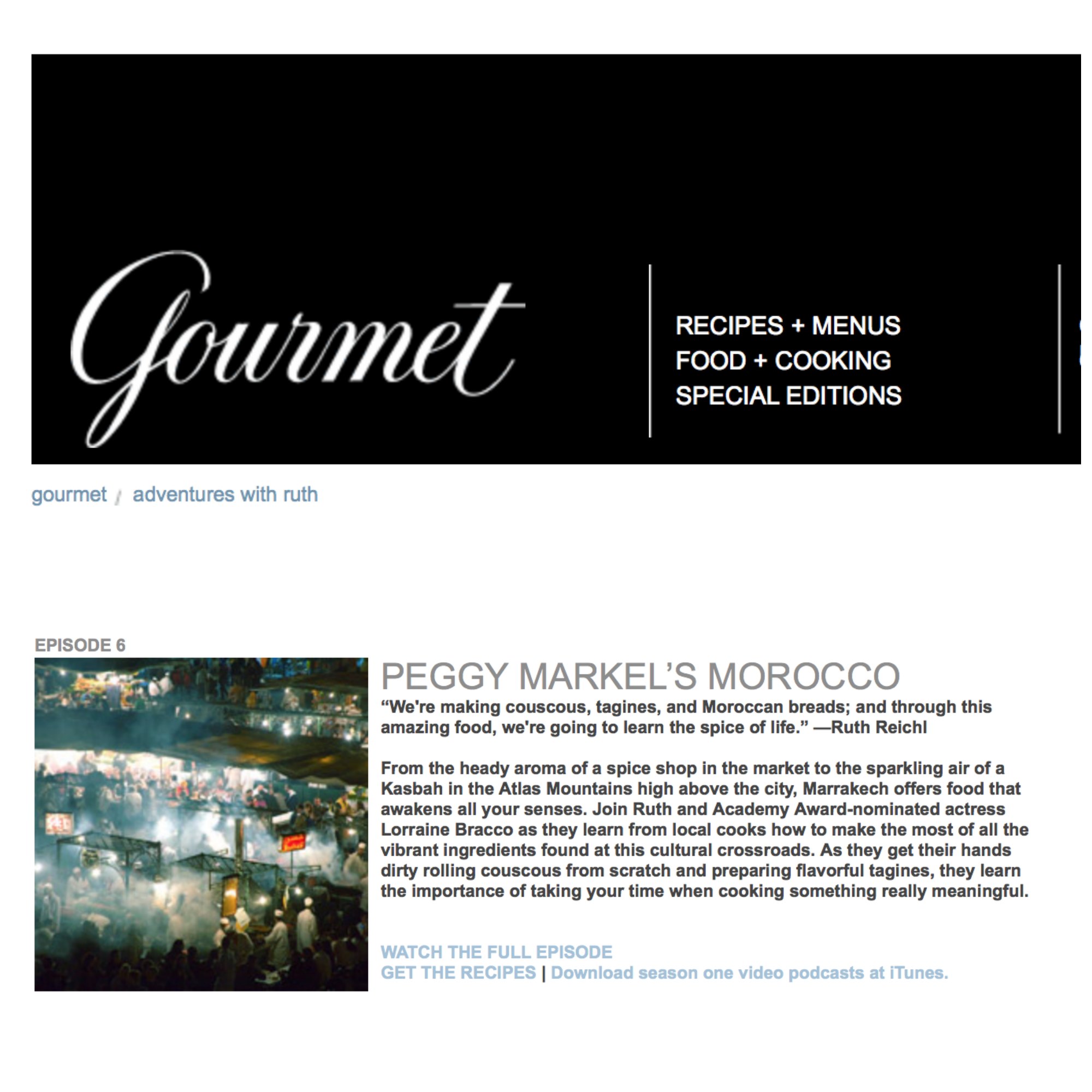
In Marrakech, Morocco, on the Place Jma al-Fna, the entire square fills up with tables and outdoor grills. Colored smoke billows at sunset.You can get boiled eggs dipped in salt and cumin, kebabs of every kind of meat, snails cooked in a spicy broth, pancakes with honey, freshly squeezed orange juice, a choice of dates, dried figs and heaps of slightly bitter almonds. Needless to say it’s lively. It pulses like an ancient heartbeat. A sit-down meal becomes a kind of exotic dinner theater, with the sound of drums and snake charming clarinets in the background.You can watch fire breathers, acrobats and transvestite belly dancers and even get your fortune told between courses – all for about eight dollars. It makes Halloween look a little pallid. The streets don’t empty before three or four in the morning when, as if a dream, it all disappears until five p.m. the next day.
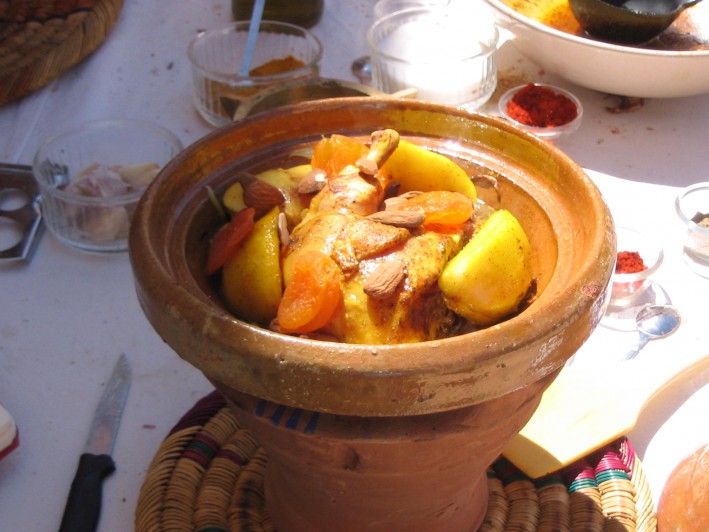
Apart from traditional dishes, Morocco offers a delectable palate of spices, vegetables and fruits with which to create a light summer meal. One of my favorite ingredients to play with is the preserved lemon. Simple to prepare, you need only two ingredients: lemons and salt. Cut a cross in the top of the lemon (not all the way through). This gives you four wedges to stuff a good quality salt into.Then you press them in a jar as tight as you can. Then turn the jar upside down. They’ll hold their flavor better under fire. A lemon risotto takes on a completely different taste with preserved lemons, which are also traditionally used in the chicken tagine with olive and lemon confit.
When preserved, I love to blend lemons with olive oil to make a paste.This can be added to dressings, used as a garnish for soups or left sliced on a plate as an after dinner digestive. They are also fabulous with martinis as an alternative to olives.
An ideal salad for summer is couscous tabouleh with tons of fresh parsley, mint, pine nuts and cucumbers, and a few cherry tomatoes, as well. I make a strong dressing of extra virgin olive oil, lemon juice, a spoonful of preserved lemon paste, salt and pepper. I substitute couscous for bulghar, as it seems lighter and a touch more sophisticated. It’s substantial without being heavy, and it’s fresh. It’s an easy picnic dish and it travels well ... even if only as far as the backyard.
At Jnane Tamsna, 15 minutes from Marrakech in the Palmeraie, I foraged in the garden for mint and parsley and all the rest. Ibrahim, who works there, helped me set some carpets over the grass and a large brass tray on a table base. He decorated it simply with citrus and rosemary. Round semolina barley breads were stacked on the table and the couscous tabouleh was served in a glass. There was melon and mint tea for dessert. My friend Laurel and I sat happily on pillows, chewing slowly, appreciating that every ingredient except the couscous had come from the garden – even the lemons and olive oil!
Eating out in a restaurant is a total pleasure when it’s good, but twice a day can get old (not to mention pricey) even when the food is delicious. People need simple food without too much elaboration. “Too much of a good thing” can be too much. We need equilibrium in our lives; a “not too much, not too little” approach on all levels, both of which can be particularly hard when on the road.
Recently, I was with a group of people in southern Sicily. We didn’t need to sit down to yet another big meal. It was time to get off the beaten path. We collected some local delicacies from the town of Modica such cacciocavallo ragusano, an aged cow’s milk cheese from the province of Ragusa. Instead of bread we chose a foccaccia ragusana, folded like an empanada and stuffed with various combinations of fresh vegetables, soft cheeses and tomato sauce. A picnic wouldn’t seem right without local olives and sun dried tomatoes, local wine and not to be believed ... local chocolate!
It was fun exploring, looking for a place to stop and spread out our tablecloth. This area of southern Sicily is incantavole (enchanting). The high plains of the Iblei are terraced, sectioned off by low stonewalls called muri a secca (meaning dry – there is nothing holding them together). Within the stone boundaries one can find a magnificent carob tree, with olive trees dotted about, and maybe some wheat growing underneath. The fields are also home to the black and white cows, razza modicana, who munch on 700 varieties of grasses and herbs that make the fabulous and Slow Food Movement-protected cheese formaggio ragusano.
After the wheat is harvested, the golden shafts lay on the ground, creating a soft bed to sit upon just perfect for a picnic.We found our chosen spot with a great view and Ciccio, our token Sicilian, chose the perfect tree where we could spread out a few old flat cotton sheets that provided a most elegant table on the ground. He pulled up flat rocks in case someone wanted a proper seat. We laid down our collections and delved enthusiastically into the various offerings. We were like children on a field trip. Everything tasted so delicious – eating with the elements stimulates the senses. We remembered our muse. Ciccio was so moved he broke into a spontaneous aria. His voice carried for miles as he sang “O Sole Mio” deeply from his soulful Sicilian dialect. We found out his father is a Maestro. Ciccio, the gypsy bus driver, also sings opera. It was a moment in time that we tapped into, just by creating the space for it to happen. We were out of doors. The sky was the limit, in this anonymous field under an olive tree, with a touring group of people who didn’t know each other well. Candied orange peel and spicy chocolate, our desert, will
always be associated with that memory.
Nature has no lack of style and flair. Wherever you choose to lay down your tablecloth will offer you the muse. All you have to do is find the right spot and feel the love. Or, just step out your front door with an apple.

Couscous Tabouleh
For a quick couscous:
1 cup dry couscous
1 1/2 cups water
a pinch of salt
a drizzle of olive oil
Bring water to a boil. Pour in couscous and stir until it absorbs the water.
(around two minutes). Turn off the heat, cover and leave for five minutes.
Take lid off and fluff the couscous with a fork. Put in a large bowl.
Then prepare:
2 cups cherry tomatoes, cut in quarters
1 cup of parsley, finely chopped
1/2 cup of mint, finely chopped
1/4 cup toasted pine nuts
For the marinade:
1 cup extra virgin olive oil
1/2 cup of fresh lemon juice
1/2 of a preserved lemon, finely chopped (optional)
salt to taste
a pinch of cayenne (optional)
Add the tomatoes, parsley, mint and pine nuts to the bowl ofcouscous. Mix marinade separately. Add to other ingredients and toss. Correct for salt, lemon and spice. Serve in a glass of your choice.
Rucula con Pomodorini, Gamberi e Limone Amalfitane
Arugula Salad with Shrimp, Cherry Tomatoes & Lemons Amalfi Style
3 bunches of arugula, rinsed and air dried
1 cup cherry tomatoes
6 shrimp, peeled
2 cloves of garlic, peeled and chopped
1 tablespoon of parsley, chopped fine
5 thinly sliced lemon rounds, sliced in strips
1/2 lemon, juiced
extra virgin olive oil
a pinch of salt to taste
Slice cherry tomatoes in half and toss with arugula. Peel the shrimp and sauté with garlic, parsley and olive oil. Splash with white wine. Put the shrimp in a bowl and cover with a plate for three minutes. Add to salad. Drizzle with extra virgin olive oil and a dash of salt.
Squeeze lemon juice over the salad. Slice lemon rounds into strips. Toss all ingredients together. Salt to taste. Enjoy!
Click here to download pdf
© Copyright Peggy Markel 2008. All rights reserved.
|